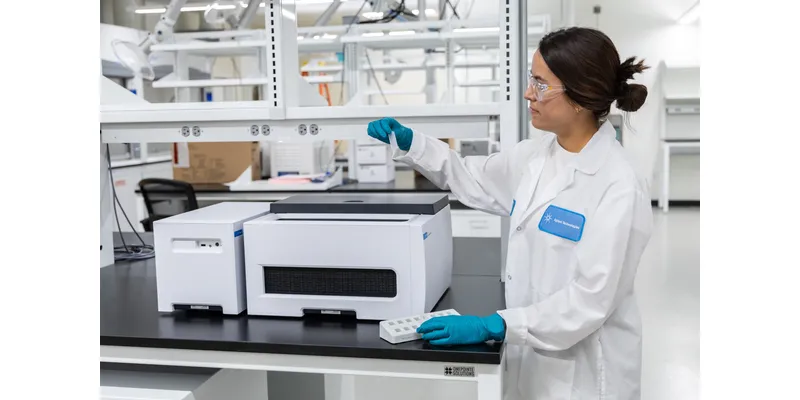
Agilent Technologies has added new laboratory space in Boulder, Colorado, to develop and scale enzymatic ligation technology for oligonucleotide manufacturing. The facility operates through the Agilent Advanced Therapeutics contract development and manufacturing organization (CDMO), complementing existing oligonucleotide operations in Colorado and manufacturing capabilities in Canada. The approach uses ligase enzymes to join shorter, pre-synthesized oligonucleotide fragments into full-length therapeutic molecules.
Solid-Phase Synthesis: Where Scale-Up Pressure Builds
Solid-phase phosphoramidite synthesis faces increasing pressure as therapeutic oligonucleotide programs grow longer and more structurally complex. Reagent consumption, synthesis cycle efficiency, and purification burden can all become limiting as programs advance toward commercial scale. Blake Unterreiner, vice president and business unit leader for Agilent's Advanced Therapeutics Division, notes: "The additional laboratory space gives our teams a dedicated environment to further evaluate the customer's enzymatic ligation processes and respond to evolving customer manufacturing needs."
The regulatory environment is also evolving. The European Medicines Agency's draft oligonucleotide manufacturing guideline, published for consultation in 2024, sets out requirements for process characterization, impurity control, and analytical control strategies for synthetic oligonucleotides. Manufacturing partners who can demonstrate compliance readiness across multiple synthesis approaches are increasingly in demand as programs move toward commercialization.
Working in analytical science?
Register for a FREE Separation Science account to subscribe to the Separation Science Newsletter.

The Boulder facility covers five key aspects of Agilent's enzymatic ligation program:
- Technique: Ligase enzymes join shorter oligonucleotide fragments (blockmers) into longer therapeutic molecules
- Modalities Served: Small interfering RNA (siRNA) and antisense oligonucleotides (ASOs) under cGMP conditions
- Manufacturing Approach: Complement to solid-phase phosphoramidite synthesis, not a replacement
- Facility Function: Process R&D and scale-up, with pathways to tech transfer at production scale
- Customer Programs: Initial programs expected to begin November 2026, subject to operational and regulatory requirements
Which Oligonucleotide Programs Benefit From Enzymatic Ligation?
Enzymatic ligation is best suited to programs where sequence length, reagent efficiency, or process sustainability demands exceed what solid-phase-only workflows can support. A substantial pipeline of siRNA and antisense therapies addressing cardiovascular, rare disease, and hepatic indications is advancing toward commercial manufacturing, each asset carrying distinct requirements for modification complexity and scale.
Chemoenzymatic ligation pairs phosphoramidite-synthesized blockmers with enzymatic joining chemistry, and is gaining traction as programs grow in structural complexity and batch size. Longer sequences benefit most. Agilent's Boulder and Frederick, Colorado cGMP facilities have been regularly inspected by the FDA since 2015.
The table below compares the two synthesis approaches across five parameters relevant to program selection:
| Manufacturing Approach | Solid-Phase Phosphoramidite Synthesis | Enzymatic Ligation |
|---|---|---|
| Mechanism | Sequential nucleotide addition on solid support | Enzymatic joining of pre-synthesized oligonucleotide fragments |
| Suited for | Short-to-medium oligonucleotides; established cGMP platform | Longer, complex oligonucleotides; emerging commercial scale-up |
| Reagent Profile | High phosphoramidite and solvent consumption per cycle | Potentially lower per-residue reagent use for longer sequences |
| Purity Strategy | Chromatographic purification post-synthesis | Purification of fragments and final ligation product |
| Regulatory Status | Extensive FDA and EMA precedent | Growing regulatory interest; guidance frameworks developing |
Oligonucleotide Manufacturing Flexibility Expands With Boulder Investment
Platform selection in oligonucleotide manufacturing is increasingly driven by a program's specific sequence length and scale needs. The Boulder laboratory is a process R&D facility, not a commercial manufacturing line, built to evaluate enzymatic ligation workflows ahead of larger-scale cGMP deployment. With initial customer programs expected in November 2026, the facility adds a complementary synthesis capability to Agilent Advanced Therapeutics' oligonucleotide manufacturing network spanning Colorado and Canada.
This article is based on a press release issued by Agilent Technologies and was produced under Separation Science's AI Editorial Guidelines.