

Targeted LC-MS/MS methods provide sensitive quantitation for named PFAS, but they measure only compounds included in the analytical list. Broader approaches can reveal precursor or organofluorine signals outside that list, though they may sacrifice compound-level identification.
These methods answer different questions. Laboratories should select them according to the information needed rather than treat them as competing measurements of the same quantity.
Compare the Analytical Approaches
The main distinction lies in what each result represents.
Approach | What It Measures | Main Limitation |
Targeted analysis | Concentrations of specified PFAS | Misses compounds outside the target list |
TOP assay | Change in measurable PFAAs after oxidation | Does not identify every original precursor |
AOF | Organofluorine retained on activated carbon | Cannot identify individual compounds |
EOF | Organic fluorine transferred into an extract | Depends on extraction coverage |
TOF | Broader organic-fluorine measurement | Limited compound-level information |
Non-target analysis | Features or compounds detected without a fixed target list | Identification and quantitation can remain uncertain |
The results cannot be added or compared without considering units, recovery, fluorine equivalents, and the fraction captured by each procedure.
Targeted Analysis: Quantifying Known Compounds
Targeted methods use authentic standards and defined identification criteria to measure named PFAS. EPA Method 1633A measures 40 PFAS across several environmental matrices using LC-MS/MS.
This approach provides the strongest route to compound-specific quantitation. It supports reporting limits, quality-control criteria, and comparison with compound-specific regulatory thresholds.
Its boundary is the target list. A non-detect means that the method did not identify a listed compound above the applicable threshold. It does not show that the sample contains no other PFAS or organofluorine.
Working in analytical science?
Register for a FREE Separation Science account to subscribe to the Separation Science Newsletter.

Targeted analysis can also use other analytical platforms for different chemical fractions. Atmospheric PFAS measurements, for example, require methods suited to volatile and particle-associated compounds that routine aqueous LC-MS/MS may not capture.
TOP Assay: Revealing Oxidizable Precursors
The total oxidizable precursor assay treats a sample with strong oxidative conditions that convert some PFAS precursors into measurable perfluoroalkyl acids. The laboratory compares targeted results before and after oxidation.
An increase in terminal PFAAs indicates the presence of oxidizable precursors that the original targeted analysis did not capture. This can reveal a hidden precursor contribution in wastewater, aqueous film-forming foam-affected samples, and other complex matrices.
TOP does not measure every PFAS precursor. Some compounds resist oxidation, while the products do not always identify the original precursor. The result should therefore describe the increase in measured oxidation products rather than claim a complete total-PFAS concentration.
AOF: Screening Adsorbable Organofluorine
EPA Method 1621 passes an aqueous sample through granular activated carbon and measures the retained fluorine by combustion ion chromatography.
AOF provides an aggregate organofluorine result. PFAS may contribute, but so can non-PFAS fluorinated substances such as some pharmaceuticals and pesticides.
EPA defines AOF as a method-defined parameter because the result depends on the adsorption and measurement procedure. The method does not capture all organofluorines with equal efficiency and cannot identify the compounds responsible for the signal.
AOF works best as a complement to targeted analysis.
EOF and TOF: Exploring the Fluorine Gap
Extractable organic fluorine measures the fluorine transferred from a sample into an organic extract. The result reflects both the fluorinated compounds present and the extraction procedure’s ability to recover them.
Total organic fluorine aims to measure a broader organic-fluorine fraction. Terminology and procedures can vary, so laboratories should define exactly what the measurement includes and how inorganic fluoride is separated or accounted for.
Researchers can compare targeted PFAS expressed as fluorine equivalents with EOF or TOF. A larger organofluorine result may indicate an unexplained fluorine gap.
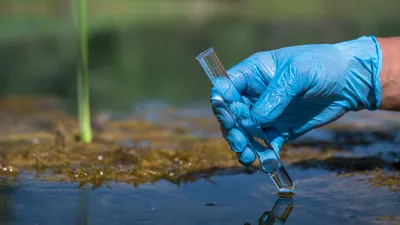
That gap does not prove that all unassigned fluorine comes from unidentified PFAS. Extraction differences, non-PFAS organofluorines, and measurement uncertainty can also contribute. The discussion of trace-level PFAS analysis from a Canadian perspective explores how broader fluorine measurements can complement targeted workflows.
Non-Target Analysis: Searching Beyond a Fixed List
Non-target analysis commonly uses high-resolution mass spectrometry to detect chemical features without limiting acquisition to a predefined target list. Analysts can use accurate mass, isotope patterns, fragmentation, and retention behaviour to propose identities.
This approach can discover emerging PFAS, transformation products, and compounds absent from routine panels. It can also support retrospective analysis when full-scan data remain available.
Identification confidence varies. Some features can be confirmed with an authentic standard, while others remain tentative structures or molecular formulas. Quantitation also becomes difficult when no matched standard exists.
Non-target results should therefore state the level of identification confidence and distinguish confirmed compounds from candidates.
Combine Methods Around the Question
A tiered strategy often provides the clearest picture. Targeted analysis measures known compounds. TOP investigates oxidizable precursors. AOF, EOF, or TOF assesses a broader organofluorine fraction. Non-target analysis then helps investigate unexplained signals.
These approaches do not produce one interchangeable definition of “total PFAS.” Their value comes from showing different parts of the sample’s chemical composition and making the remaining uncertainty visible.
This article was produced under Separation Science's AI Editorial Guidelines.

