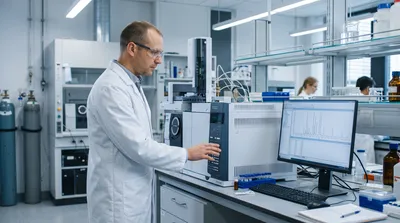
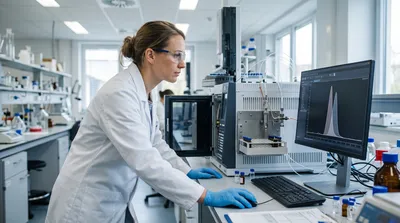
The most common reason a first GC run produces a useless chromatogram is not a column problem but poorly chosen starting conditions. Setting initial GC method parameters deliberately before the first injection, rather than adjusting in response to a poor run, is the practical approach described throughout Intermediate Gas Chromatography: The Working Analyst's Guide.
Key Takeaways
- Set the initial oven temperature approximately 45°C below the boiling point of the lowest-boiling component of interest to provide adequate retention without excessive run time.
- Use a ramp rate of 10–15°C/min as a starting point; adjust faster for throughput or slower for resolution once the first chromatogram is in hand.
- Target the optimal linear velocity for the carrier gas in use: approximately 30–40 cm/s for helium, 40–55 cm/s for hydrogen, and 10–15 cm/s for nitrogen.
- Set the inlet temperature 50°C above the boiling point of the highest-boiling analyte; for most samples this falls between 250°C and 300°C.
- Start with a split ratio of 50:1 for concentrated samples and adjust once the approximate analyte concentration range is established.
Setting Initial GC Oven Temperature from Sample Boiling Points
Build the oven temperature program around the sample, not the instrument manual. For a new method, start with an initial oven temperature approximately 45°C below the boiling point of the lowest-boiling component of interest; this provides enough retention to produce resolved early peaks without unnecessarily extending the run.
If boiling point data are not immediately available, the NIST Chemistry WebBook provides reliable physical property data for a wide range of compounds and can be consulted in minutes. The anchor for this calculation should be the lightest analyte, not the solvent; the solvent typically elutes near the dead time and is not a useful reference point for analyte retention.
Choosing a GC Oven Temperature Program for the First Run
A ramp rate of 10–15°C/min suits most first-run GC oven temperature programs. It is fast enough to keep run time reasonable, and slow enough that compounds with similar boiling points have time to separate before the program moves past them. Set the final temperature 10–20°C above the boiling point of the highest-boiling analyte, keeping at least a 20°C margin below the column's maximum operating temperature.
A hold of two to five minutes at the final temperature is worth including even on a first run. If any late-eluting compounds or degradation products are present, this hold confirms the column is clean before the next injection, and an unexpected late peak is diagnostic rather than a surprise.
Setting GC Carrier Gas Flow Rate and Pressure
Set the carrier gas flow to achieve the optimal linear velocity for the gas in use. The van Deemter relationship between carrier gas velocity and column efficiency shows a clear minimum in plate height at a characteristic linear velocity for each carrier: approximately 30–40 cm/s for helium, 40–55 cm/s for hydrogen, and 10–15 cm/s for nitrogen. Running outside these ranges costs efficiency without compensating benefit on the first run.
For a standard 30 m × 0.25 mm capillary column with helium, a head pressure of 60–80 kPa produces linear velocity in the correct range at a 40°C initial oven temperature. Verify linear velocity by injecting a non-retained compound such as methane and calculating hold-up time directly; the instrument's calculated value assumes ideal column dimensions and is less reliable.
Setting carrier gas velocity correctly is one of the foundational skills in the Analytical Training Solutions Intermediate GC course, where the first module is free if you want to see how the course connects column efficiency theory to practical setpoint decisions.
GC Inlet Setpoints: Temperature, Split Ratio, and Mode
The inlet temperature should be high enough to vaporize the least volatile compound of interest completely and immediately on injection. A starting value of 50°C above the boiling point of the highest-boiling analyte ensures complete vaporization while avoiding thermal stress on labile compounds; for most methods this puts the inlet temperature between 250°C and 300°C.
For a first run on an unknown sample, a split ratio of 50:1 is a sensible default. It protects the column from overloading while leaving enough analyte on-column to produce measurable peaks for the major components. If peaks are too small to evaluate properly, reduce the split ratio on the next injection; trace-level work may eventually require splitless mode, but evaluating those additional variables only makes sense once a split run has established the approximate analyte concentration range.
The inlet choices made here connect directly to the hardware decisions involved in selecting GC columns, inlets, and detectors. They also feed forward into any future GC method translation work, where column format and carrier gas changes must preserve the separation achieved in the initial run.
This article draws on the Intermediate Gas Chromatography course from Analytical Training Solutions, which covers initial GC method parameters and setpoint selection with worked examples and step-by-step instruction. You can try the first module of any Analytical Training Solutions course free from the course catalog to see how the training is structured before you commit.
This article was produced under Separation Science's AI Editorial Guidelines.