Curio HS Brings Parallel Headspace Extraction to Food, Beverage, and Fragrance Labs
Quantera's Curio HS prepares 24 headspace samples in parallel, cutting per-sample cost by up to 80% and adding DART-MS compatibility to existing lab workflows
Updated
Written bySharon Dong
Terry Bates and Matt Scimeca load samples into the Curio HS multiwell plate for parallel headspace extraction of volatile food and beverage compounds.
Quantera Analytical, a Cornell University spinout, introduced the Curio HS: a parallel, cartridge-based headspace extraction platform for trace-level testing of volatile and semi-volatile compounds in food, beverage, and fragrance matrices. Paired with direct analysis in real time mass spectrometry (DART-MS), it delivers up to 60x throughput improvement and up to 80% per-sample cost reduction over conventional fiber-based solid-phase microextraction (SPME). Both gains are achievable on instruments laboratories already own.
"The Curio HS eliminates the sample preparation bottleneck that has limited what you can test for and what tool you can measure it on," remarks Terry Bates, PhD, founder and CEO of Quantera. "It's a dramatic expansion of trace-level testing workflows, and we're already seeing an extraordinary amount of industry interest."
Uniform spring pressure seats all Curio HS cartridges simultaneously, completing the parallel headspace sample preparation step in under two minutes.
Quantera Analytical
Is One-at-a-Time SPME the Bottleneck in Headspace Testing?
Fiber-based SPME constrains headspace analysis throughput to a single sample per extraction cycle, restricting both processing rate and the range of sorbent chemistries a laboratory can deploy. As the FDA's food method guidelines make clear, method robustness and reproducibility across matrices are central requirements in food safety testing: serial fiber extraction makes both difficult to achieve at production scale. Reviews of why SPME sorbent chemistry matters show why broadening beyond fiber-compatible chemistries has long been a practical objective, even as the format itself stayed unchanged.
Working in analytical science?
Register for a FREE Separation Science account to subscribe to the Separation Science Newsletter.
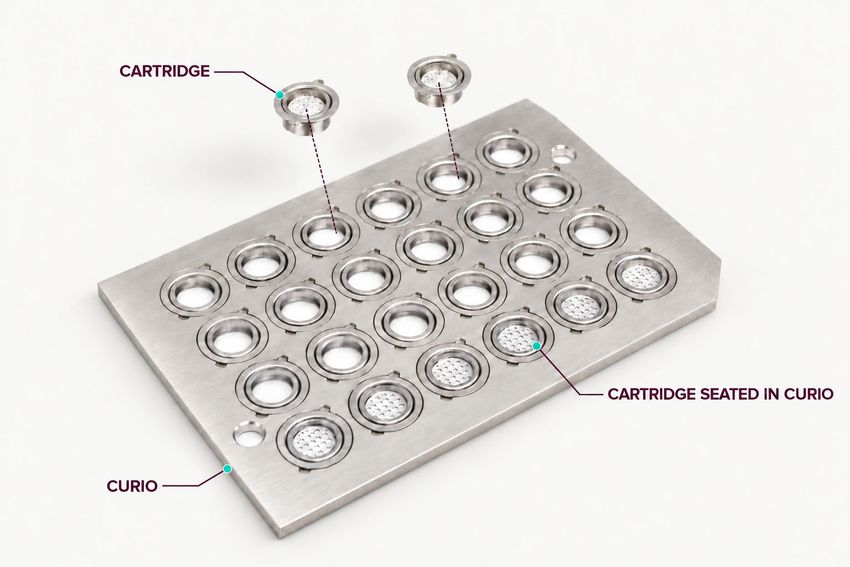
The Curio HS redesigns headspace analysis around a parallel, cartridge-based geometry developed by Professor Gavin Sacks at Cornell University, underpinned by over twelve peer-reviewed publications. Samples load into a 24-well plate on the standard footprint; a matching array of sorbent cartridges seals over every well at once, with under two minutes of preparation per sample. Quantera holds an exclusive license to the Cornell patent portfolio covering the extraction geometry and workflow, as documented in Cornell's technology licensing profile.
The Curio HS plate seats one sorbent cartridge above each of its 24 wells simultaneously, enabling parallel headspace extraction across an entire sample batch.
Quantera Analytical
Platform Design: Cartridge Format and Sorbent Flexibility
Because the sorbent sits in a replaceable cartridge rather than on a coated fiber, laboratories can select from conventional polymers or advanced sorbent chemistries for any given target compound without changing the device or workflow. Quantera describes the design as enabling cutting-edge and novel sorbent chemistries, processed in parallel and compatible with chromatography-free mass spectrometers that read a sample in seconds. Loaded cartridges can also be shipped from the field to a central laboratory, removing the need to transport raw perishable material.
At launch, the Curio HS delivers measurable gains across parallelism, economics, and instrument reach, with no requirement to trade one for another:
Format: 24-well plate; one cartridge per well, extracted in parallel
Preparation time: Under two minutes per sample
Throughput vs. fiber-based SPME: Up to 60x improvement with DART-MS
Per-sample cost reduction: Up to 80% with DART-MS; approximately 50% on GC-MS
Instrument compatibility: GC-MS, GC-FID, DART-MS, and other chromatography-free mass spectrometers; LC workflows in development
Sorbent flexibility: Interchangeable single-use cartridges in conventional and advanced chemistries
Headspace Analysis: Breaking the Throughput Barrier Across Industries
Across wine, food, dairy, and environmental testing, the Curio HS addresses sectors where trace-level volatile compound analysis is routine but throughput bottlenecks have prevented every-lot screening. In wine production, smoke-taint volatile phenols and cork-taint markers such as 2,4,6-trichloroanisole (TCA) are now testable across dozens of vineyard blocks with same-day headspace analysis results. Beer and spirits monitoring for off-flavors, food and dairy screening for fumigant and spoilage compounds, and contract laboratory workloads covering BTEX (benzene, toluene, ethylbenzene, and xylene) and broader VOC panels all fall within the platform's scope.
Established SPME headspace analysis methods transfer to the Curio HS with minimal reoptimization. Ongoing validation work with the USDA Agricultural Research Service points toward validated food safety extraction methods that will support adoption in regulated testing environments.
Across the seven parameters below, several differences are structural rather than incremental:
Parameter
Curio HS (Cartridge-Based)
Fiber-Based SPME (Conventional)
Extraction format
Parallel; 24 samples per plate
Sequential; one sample at a time
Throughput (with DART-MS)
Up to 60x vs. fiber-based
Baseline reference
Per-sample cost (DART-MS)
Up to 80% reduction
Baseline reference
Per-sample cost (GC-MS)
Approximately 50% reduction
Baseline reference
Sorbent flexibility
Interchangeable cartridges; conventional and advanced chemistries
Limited to commercial fiber coatings
Sample shipping
Cartridge ships from field; no perishable transport required
Raw sample or vial must reach the instrument
Instrument compatibility
GC-MS, GC-FID, DART-MS, LC (in development)
Primarily GC-MS and GC-FID
Bruce Pan, Director, Chemistry, Research and Applications at E. & J. Gallo Winery, notes the collaborative origins of the platform: "Curio is the product of nearly a decade of research partnership between Cornell University and E. & J. Gallo Winery. That collaboration was instrumental in launching Quantera and continues to support the advancement and early application of Curio."
Curio HS: Parallel Cartridge Extraction for Routine Headspace Testing
The Curio HS moves headspace analysis from a serial, fiber-dependent format into a scalable, cartridge-based workflow that brings trace-level volatile testing within reach for food, beverage, fragrance, and environmental laboratories. Compatible with existing GC-MS and DART-MS instrumentation, it requires no replacement of current infrastructure to adopt. Quantera will offer early-access partners complimentary method development to transition an existing headspace analysis method onto the platform.
This article is based on a press release issued by Quantera Analytical and was produced under Separation Science's AI Policy.
Add Separation Science as a preferred Google source to see more of our trusted coverage
Sharon Dong, BSc (Hons), MSc joined LabX Media Group (LMG) in 2026 as a Product News & Intelligence Editor. She has a strong background in cellular biology, microbiology, immunology, and molecular genetics. She is an experienced science education and outreach facilitator. Sharon is passionate about communicating science in ways that are clear, engaging, and accessible to a broad audience. In her free time, she enjoys solving jigsaw puzzles and cooking. Sharon can be reached at sdong@labx.com.