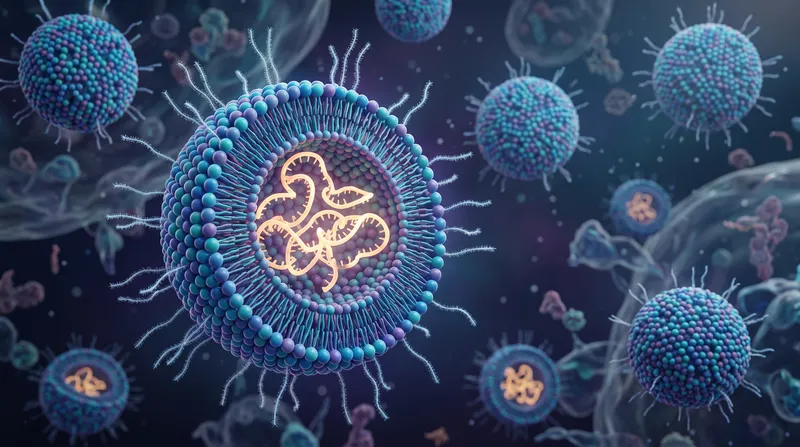
The explosive success of mRNA vaccines has cemented RNA-based therapeutics as a cornerstone of modern medicine. However, the efficacy of these therapies relies entirely on their delivery systems: lipid nanoparticles (LNPs). While the analytical focus historically centered on the oligonucleotide active pharmaceutical ingredient (API), the spotlight has definitively shifted toward the LNP vehicle itself.
LNPs are highly complex, multicomponent systems, and their structural integrity is paramount to both the safety and translation efficiency of the RNA payload. This analytical shift demands robust LNP characterization mass spectrometry workflows capable of precisely quantifying individual lipid components, profiling impurities, and monitoring degradation pathways.
The Analytical Complexity of the LNP Delivery System
A typical LNP is formulated using four distinct lipid classes, each presenting unique analytical challenges:
Ionizable Cationic Lipids: The critical component that binds the polyanionic RNA and facilitates endosomal escape. These are often proprietary, highly complex, and prone to degradation.
PEGylated Lipids (PEG-lipids): Provide stealth properties to evade the immune system and control particle size. They present as highly polydisperse mixtures, complicating chromatographic separation.
Helper Phospholipids (e.g., DSPC): Support the structural bilayer.
Cholesterol: Provides structural stability and regulates membrane fluidity.
Because these components span a wide range of polarities and structural variations, a single analytical method rarely captures the full picture. Advanced lipid nanoparticle LC-MS strategies must be deployed to resolve these mixtures without co-elution and ion suppression.
Working in analytical science?
Register for a FREE Separation Science account to subscribe to the Separation Science Newsletter.

Chromatographic Strategies: Separating the LNP Matrix
For the baseline quantification and purity analysis of the intact lipid components, Reversed-Phase Liquid Chromatography (RPLC) using sub-2-micron C18 or C8 columns is the standard approach.
A significant challenge in mRNA vaccine analytical testing is that while ionizable lipids and DSPC ionize well under positive electrospray ionization (ESI+), cholesterol and certain PEG-lipids exhibit notoriously poor ionization efficiency. To overcome this, method developers frequently utilize a dual-detector setup: coupling the LC to both a High-Resolution Mass Spectrometer (HRMS) and a Charged Aerosol Detector (CAD).
The CAD provides near-universal, mass-independent quantification of all lipid components—even those that do not ionize well—while the MS provides the structural elucidation and exact mass confirmation necessary for identifying unknowns. Utilizing mobile phases buffered with ammonium formate or ammonium acetate (often paired with methanol or isopropanol gradients) is critical to maintaining sharp peak shapes and optimal ionization across both detectors.
Harnessing HRMS for Degradation and Impurity Profiling
Where traditional LC-UV or LC-CAD falls short is in identifying the trace-level breakdown products of the LNP components. This is where high-resolution LNP characterization mass spectrometry (utilizing Q-TOF or Orbitrap systems) becomes non-negotiable.
Tracking Ionizable Lipid Degradation
The ionizable cationic lipid is the most critical and vulnerable component of the LNP. Over time, or under sub-optimal storage conditions, these lipids undergo specific degradation pathways, primarily oxidation and hydrolysis.
A major focus of current ionizable lipid degradation studies is the formation of N-oxides and related oxidative species. These reactive degradants are highly problematic; they can form covalent adducts with the mRNA payload itself, physically blocking ribosomal translation and rendering the therapeutic completely inactive. HRMS workflows utilizing data-dependent acquisition (DDA) or data-independent acquisition (DIA) allow analytical chemists to screen for these oxidative mass shifts (e.g., +16 Da or +32 Da) with sub-ppm mass accuracy.
Comprehensive LNP Impurity Profiling
Beyond degradation, the raw lipid materials used in LNP manufacturing often contain synthetic impurities. For instance, PEG-lipids can contain varying chain lengths of the polyethylene glycol moiety, which can alter the pharmacokinetic profile of the final drug product.

For rigorous LNP impurity profiling, analysts rely on exact mass MS/MS fragmentation patterns. By examining the diagnostic product ions generated in the collision cell—such as the characteristic m/z 184.07 ion for the phosphocholine headgroup of DSPC, or specific fragment ions unique to the proprietary ionizable lipid tail—chemists can structurally characterize unexpected peaks in the chromatogram and trace them back to synthesis byproducts or raw material contamination.
Conclusion
As the pipeline for RNA interference (RNAi), antisense oligonucleotides, and CRISPR/Cas9 therapies expands, the analytical burden on formulation and quality control labs will only intensify. Ensuring the stability of the LNP is intrinsically linked to the efficacy of the drug. Laboratories driving the future of genetic medicine must adopt sophisticated lipid nanoparticle LC-MS techniques, leveraging the combined power of high-efficiency RPLC, universal detection via CAD, and the structural resolving power of HRMS to fully decode the vehicle delivering these revolutionary therapeutics.