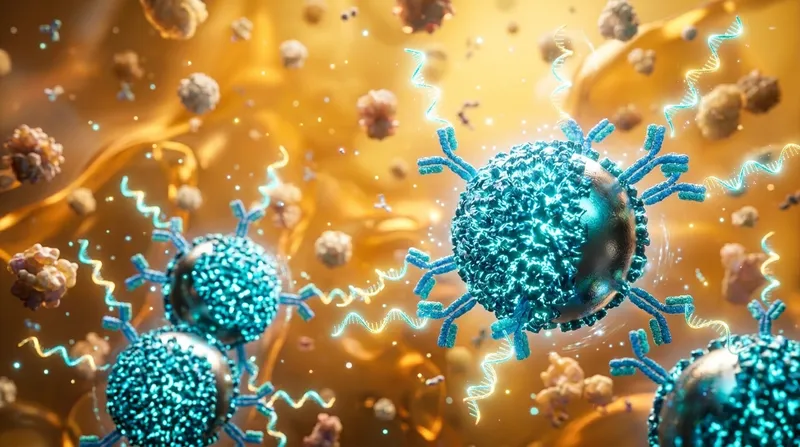
An antibody conjugate enters a pharmacokinetic study as one therapeutic construct, but following its components requires several analytical measurements. An assay that tracks the antibody answers a different question from one that measures its associated payload. Sample preparation determines which of those questions the LC–MS result can address.
In a recent Phenomenex symposium, Rathna Veeramachaneni, Ph.D., Director, Mass Spec Bioanalysis – Development at KCAS Bio, explored that distinction through workflows for complex antibody conjugates. Her human plasma case study combined magnetic bead enrichment with LC–MS analysis to measure different components of an antibody–RNA conjugate.
Veeramachaneni explains that measuring total antibody can be achieved by looking at a part of the antibody that is unique to that antibody. Monitoring the antisense strand requires a different preparation route, and its interpretation depends on the ability to successfully capture the conjugate.
Three Assays for One Conjugate
Veeramachaneni describes three measurements for the antibody–RNA conjugate case: total antibody, conjugate-associated antisense, and total antisense. The construct contains an RNA duplex whose sense strand attaches to the antibody. The associated antisense strand provides the analytical target for the oligonucleotide measurements.
Working in analytical science?
Register for a FREE Separation Science account to subscribe to the Separation Science Newsletter.

For conjugate-associated antisense, the workflow first enriches the antibody-containing material, then releases the antisense strand for measurement. For total antisense, the preparation processes the sample without that selective antibody capture step, accessing antisense from both conjugate-associated and free material.
The following comparison shows how each preparation route defines the measurement in the case study.
| Measurement | Key Preparation Steps | LC–MS Target |
| Total antibody | Antibody capture, elution, and tryptic digestion | Antibody signature peptide |
| Conjugate-associated antisense | Antibody capture followed by base dissociation | Antisense from captured conjugate |
| Total antisense | Proteinase K digestion and SPE without antibody capture | Antisense from conjugate-associated and free material |
The two oligonucleotide assays therefore monitor the same strand but represent different pools in the sample. The capture step creates the distinction before either extract reaches the mass spectrometer.
Combining Capture With Mass Selectivity
Hybrid LC–MS combines an enrichment step with chromatographic separation and mass spectrometric detection. In the case study, a biotinylated anti-idiotypic antibody and streptavidin-coated magnetic beads capture the target from human plasma. The team incubates the mixture, washes away nonspecific material, and prepares the captured analyte for the intended measurement.
“By dialing in the selectivity of the mass spec, we are able to identify the unique part of the molecule that we are going after,” advises Veeramachaneni.
For conjugate-associated antisense, base dissociation releases the strand, and negative-ion high-resolution MS measures it. The total antibody workflow instead uses acid elution, neutralization, reduction, alkylation, and trypsin digestion. Positive-ion LC–MS/MS then monitors a signature peptide and its labeled internal standard.
That peptide workflow also required chromatographic attention. The team observed on-column carryover and adjusted the method to address it.
“We optimized our chromatography accordingly to manage the on-column carryover that we saw,” notes Veeramachaneni. The example illustrates why selective enrichment alone does not resolve every source of analytical interference or method performance problems.
Matching Reagents to the Analytical Target
Capture reagent availability influences which workflow a laboratory can develop. Veeramachaneni discusses generic antibodies, anti-idiotypic antibodies, and anti-payload antibodies as options for different conjugates and assay objectives. Linker chemistry also affects whether the method can release a payload for measurement or needs to monitor a peptide–linker–payload species.
“The capture reagent is a critical necessity for the success of these PK assays, whether you are using a ligand-binding assay or a hybrid LC–MS technique,” explains Veeramachaneni.

Internal standards introduce another development decision. A stable-isotope-labeled protein would offer an ideal option in the approach she describes, but time and cost can limit its availability. The team instead uses heavy-labeled synthetic signature peptides, including peptides with flanking residues that allow them to undergo digestion.
Reference material also deserves attention because conjugate preparations can contain a mixture of payload-to-antibody ratios making heterogeneity a key assay development problem alongside capture selectivity and the choice of analytical target.
Optimizing Recovery for Total Antisense
The total antisense assay follows a separate extraction route. The team processes 25 µL of sample with proteinase K under denaturing conditions, then performs solid-phase extraction. Strand dissociation and elevated temperature support the antisense measurement, which uses negative-ion high-resolution MS.
Veeramachaneni compares two SPE options in this development work: Oasis WAX and Clarity OTX. For the analyte tested, Clarity OTX produced approximately twice the analyte response and a larger increase in internal-standard response. Both approaches met the reported precision and accuracy criteria in the comparison.
“This definitely is molecule dependent,” cautions Veeramachaneni. The result supports evaluating extraction conditions for the target oligonucleotide; it does not establish a universal performance advantage or a lower validated quantitation limit.
Connecting the Result to the Workflow
The case study shows how one conjugate can require several preparation and detection strategies. Magnetic bead capture supports measurements of antibody-containing material. Peptide digestion provides a route to total antibody quantitation, while a separate digestion and SPE workflow accesses total antisense.
For laboratories developing these assays, the practical question begins with the intended measurement. Capture chemistry, payload release, digestion, and extraction must all support that definition. A shared analytical target or similar LC–MS conditions do not make two assays interchangeable when their preparation steps select different material from the sample.