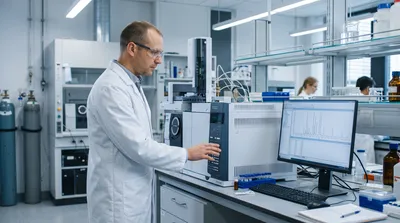
GC column selection anchors hardware configuration. The stationary phase, inlet mode, and detector all need to follow the chemistry of the sample, and getting that logic reversed costs significant rework later. Matching hardware to the sample before the method starts is the fastest route to a reliable analysis.
Key Takeaways
- Stationary phase selection follows sample polarity; a 5% phenyl, 95% polydimethylsiloxane column is the reliable default for most organic analyte work.
- The 30 m × 0.25 mm × 0.25 µm column is the standard capillary GC starting point; length, internal diameter, and film thickness each control a distinct performance variable.
- Match inlet mode to sample concentration: split injection for concentrated samples, splitless for trace analysis, and on-column injection for thermally labile analytes.
- Detector selection follows from what compound class needs to be detected and at what concentration level; the flame ionization detector is the default for most organic compound work.
GC Stationary Phase Selection: Matching Column Polarity to Sample Chemistry
The practical foundation of GC column selection is the like-dissolves-like principle: non-polar stationary phases retain non-polar analytes, and polar phases retain polar compounds. A 100% polydimethylsiloxane (PDMS) phase works well for hydrocarbons and polynuclear aromatic hydrocarbons (PAHs), eluting them in boiling point order. A polyethylene glycol (PEG) phase is the standard choice for polar analytes: alcohols, esters, and fatty acid methyl esters (FAMEs).
For most routine work, a 5% phenyl, 95% PDMS column is the sensible default: it handles diverse analyte types without excessive selectivity bias and is robust under high-throughput conditions. Target analyte boiling points and vapor pressures, available from the NIST Chemistry WebBook, give a reliable first estimate of the oven temperature range a method will require.
Stationary phase selection, with worked examples across environmental and pharmaceutical matrices, is covered in the method development module of the Analytical Training Solutions Intermediate GC course, where the first module is free if you want to see how the material is taught.
GC Column Dimensions and What They Control
Column length, internal diameter (ID), and film thickness each tune a different aspect of performance, and the three interact. A 30 m column at 0.25 mm ID and 0.25 µm film is the standard capillary GC starting point; clear justification is needed to deviate. Shorter columns (15 m) suit fast screening methods or simple mixtures; longer columns (60 m) serve complex matrices where resolution takes priority over throughput. These choices fit within the broader workflow covered in the working analyst's GC guide.
Internal diameter governs sample capacity and linear velocity: wider bore columns (0.32 mm) accept higher sample loads before peak shape deteriorates, while narrower bore columns (0.25 mm) support faster analyses at lower flows. Film thickness controls retention of volatile analytes and column bleed at elevated temperatures; thicker films are needed for species that would otherwise elute before reliable quantitation is possible. Carrier gas flow and temperature programming are the natural next decisions, addressed under initial GC setpoints.
Choosing the Right GC Inlet: Split, Splitless, and On-Column Injection
Inlet mode determines what fraction of the injected sample reaches the column and under what thermal conditions. Split injection vents a defined proportion of the vaporized sample to waste (at split ratios typically between 10:1 and 100:1), making it the correct choice for concentrated samples where column overload is a genuine risk. Splitless injection closes the split valve for a controlled hold time, maximizing analyte transfer to the column; it is the standard for trace-level work and requires careful management of solvent focusing to preserve peak shape.
On-column injection delivers the sample into the column at low temperature, bypassing the hot vaporizer and protecting thermally labile compounds that would otherwise degrade in the inlet before reaching the stationary phase. Programmed temperature vaporization (PTV) inlets support large-volume injection and in-inlet sample concentration.
GC Detector Selection: Sensitivity, Selectivity, and Method Fit
Detector selection depends on two questions: what compound class needs to be detected, and at what concentration level. The flame ionization detector (FID) is the default for most organic compound analysis: it responds proportionally to carbon, has a wide linear dynamic range, and is mechanically reliable. The thermal conductivity detector (TCD) is universal but less sensitive, remaining the practical choice for permanent gases and inorganic compounds that FID cannot detect.
For selective detection, the electron capture detector (ECD) offers high sensitivity for electronegative species such as halogenated pesticides and polychlorinated biphenyls (PCBs), while the nitrogen-phosphorus detector (NPD) targets nitrogen- and phosphorus-containing compounds in pharmaceutical and agricultural applications. Gas chromatography-mass spectrometry (GC-MS) in selected ion monitoring (SIM) mode provides structural identification where confirmation is required. The ICH Q2(R2) guidelines are a useful reference for sensitivity and specificity requirements at the validation stage. Once detector type is confirmed, operating condition optimization is covered under getting more from your detector.
This article draws on the Intermediate Gas Chromatography course from Analytical Training Solutions, which covers column, inlet, and detector selection with worked examples and step-by-step instruction. You can try the first module of any Analytical Training Solutions course free from the course catalog to see how the training is structured before you commit.
This article was produced under Separation Science's AI Editorial Guidelines.