
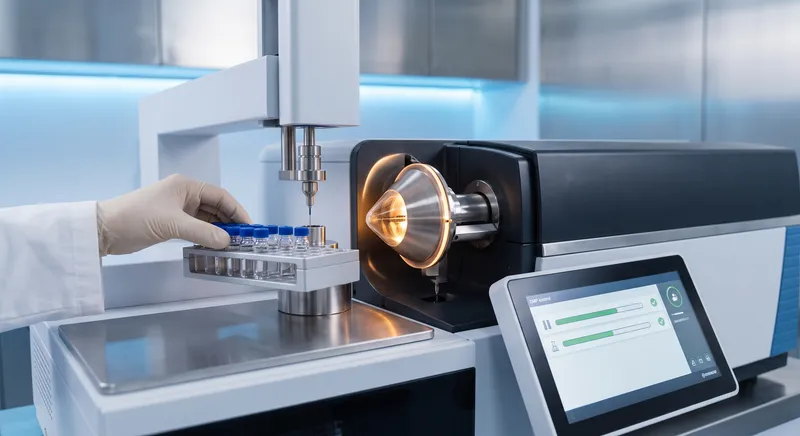
For decades, releasing a commercial biotherapeutic required a sprawling, fragmented analytical testing strategy. Quality control (QC) laboratories relied on a battery of conventional, indirect optical assays: cation-exchange chromatography (CEX) for charge variants, capillary electrophoresis (CE) for size variants, and hydrophilic interaction chromatography (HILIC) with fluorescence detection for released glycans.
The liquid chromatography-mass spectrometry (LC-MS) multi-attribute method (MAM) is actively rendering this fragmented approach obsolete. MAM utilizes high-resolution LC-MS peptide mapping to directly and simultaneously monitor multiple critical quality attributes (CQAs)—such as deamidation, oxidation, glycosylation profiling, and sequence variants—in a single, automated injection.
While MAM has been a powerhouse in biopharma R&D for characterization, the current industry inflection point is the migration of this complex workflow onto the cGMP QC floor. Moving a high-resolution mass spectrometer from a discovery lab into a strictly regulated batch-release environment requires a profound shift in mindset, software, and sample handling.
The GMP Mindset Shift: From Characterization to Monitoring
In an R&D environment, the goal of LC-MS is discovery: identifying every possible post-translational modification (PTM) and mapping the entire protein structure. In a QC environment, the goal is compliance and robustness: verifying that a predefined set of known CQAs remains within strict, validated specification limits.
Working in analytical science?
Register for a FREE Separation Science account to subscribe to the Separation Science Newsletter.

Operationalizing MAM in QC means locking the method down. The workflow transitions to a targeted "monitoring" approach. The mass spectrometer and data processing software are no longer searching for unknowns; they are programmed to extract specific precursor ions and fragment ions (often using targeted MS/MS or PRM modes) corresponding only to the peptides that carry the defined CQAs.
Software Compliance and New Peak Detection (NPD)
The largest hurdle in deploying MAM in QC is data integrity and compliance. Open-access MS software utilized in R&D cannot meet the strict 21 CFR Part 11 requirements governing electronic records, audit trails, and user permissions required on a GMP floor.
Furthermore, QC analysts cannot manually interpret complex high-resolution mass spectra. The solution lies in automated, compliance-ready MAM software packages. The defining feature of these platforms is automated new peak detection (NPD). While the software targets the predefined CQA peptides, the NPD algorithm simultaneously scans the background data. If a new, unexpected impurity (for example, a novel host cell protein or an unanticipated sequence variant) appears above a predefined threshold (such as 0.1% of the total ion current), the software automatically flags the batch for investigation. This automation eliminates analyst subjectivity and guarantees consistent batch-to-batch evaluation.
Automating Sample Preparation to Eliminate Artifacts
MAM requires enzymatic digestion (typically using Trypsin) to cleave the intact monoclonal antibody into measurable peptides. Manual peptide digestion is a highly complex, multi-step process involving denaturation, reduction, alkylation, and lengthy incubation at elevated temperatures and pH.
In a GMP environment, manual pipetting variability is unacceptable. Furthermore, the harsh conditions of sample preparation can induce artifactual modifications. If the digestion buffer pH is too high or the incubation is too long, the sample prep itself will cause deamidation and oxidation, artificially inflating the CQA levels and leading to out-of-specification (OOS) batch failures.
To successfully deploy MAM, laboratories must implement automated liquid handling platforms. Automation guarantees highly reproducible reagent addition, precise temperature control, and exact timing protocols, effectively minimizing artifactual modifications and ensuring that the measured PTMs reflect the true state of the drug product, not the skill of the analyst.
Establishing Bulletproof System Suitability Testing (SST)
Before a QC batch can be analyzed, the LC-MS system must prove it is fit for purpose. In traditional optical assays, system suitability testing (SST) is relatively straightforward. For MAM, the SST must be significantly more rigorous to account for the complexity of the HRMS instrument.
Reference Standard Digest: A highly characterized reference standard digest must be injected at the beginning of the sequence.
Chromatographic Metrics: The SST must automatically calculate and pass strict criteria for the retention time stability of specific reference peptides, ensuring the LC pumps and the analytical column are performing consistently.
Mass Spectrometer Metrics: The software must verify the mass accuracy (typically < 5 ppm error) of the instrument. If the mass calibration drifts, the targeted CQA extraction will fail.
Quantitative Thresholds: Finally, the SST must verify that the instrument is accurately quantifying the ratios. For example, the software should calculate the ratio of a known deamidated peptide to its unmodified wild-type counterpart in the reference standard. If this ratio falls outside a validated historical window (e.g., ± 10% of the expected value), the system fails suitability, and the run is halted before patient samples are consumed.

