
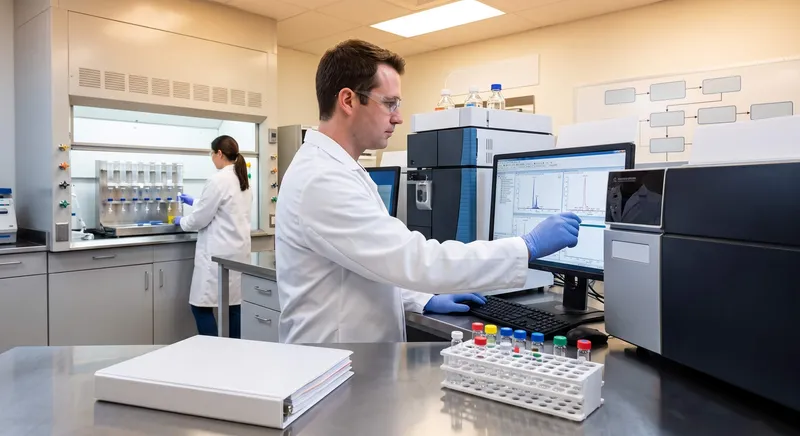
PFAS testing combines trace-level measurement with persistent risks from contamination, matrix interference, and changing regulatory requirements. Laboratories must control the complete sample pathway—from collection through final reporting—to produce results that support confident decisions.
Most routine PFAS methods use liquid chromatography–tandem mass spectrometry (LC-MS/MS) to identify and quantify a defined list of compounds. The technique provides the sensitivity and selectivity needed for trace analysis, but the instrument represents only one part of the analytical system. Sampling materials, preparation procedures, laboratory consumables, background contamination, quality controls, and reporting rules can all affect the final result.
Targeted testing also has defined limits. It measures the PFAS included in the method rather than every fluorinated compound present in a sample. Laboratories must therefore align the analytical approach with the matrix, reporting objective, regulatory program, and decisions that the data will support.
This guide connects the main stages of a PFAS laboratory workflow and directs analysts, managers, and quality teams to detailed resources for each step.
Working in analytical science?
Register for a FREE Separation Science account to subscribe to the Separation Science Newsletter.

How to Use This Guide
Laboratories can enter the workflow at different points depending on their needs:
- Laboratories establishing PFAS testing should begin with method selection, contamination control, and sample handling.
- Teams implementing a new application should focus on sample preparation, method development, and validation or verification.
- Laboratories investigating inconsistent results should review batch controls, data review procedures, and troubleshooting strategies.
- Established programs preparing for higher demand should assess competency, accreditation requirements, automation, and capacity.
Each stage influences the next. Method selection determines the samples, equipment, performance criteria, and quality controls required. Those requirements then shape laboratory setup, validation, routine batch review, and reporting.
Select the Right PFAS Method
Method selection begins with the sample matrix and reporting objective. Drinking-water laboratories may need EPA Methods 533 or 537.1, while Method 1633A covers targeted analysis across wastewater, groundwater, surface water, soil, sediment, biosolids, and tissue. Method 8327 provides a direct-injection approach for selected non-potable aqueous matrices. Method 1621 measures adsorbable organic fluorine rather than individual PFAS.
The methods do not provide interchangeable routes to the same result. They differ in scope, preparation, sensitivity, quality-control requirements, and the type of information they produce.
| Method | Primary Matrices | Measurement | Typical Role | Important Limitation |
|---|---|---|---|---|
| EPA Method 533 | Drinking water | Targeted PFAS by SPE and LC-MS/MS | Compliance and monitoring applications | Limited to its defined analyte list and matrix |
| EPA Method 537.1 | Drinking water | Targeted PFAS by SPE and LC-MS/MS | Compliance and monitoring applications | Does not cover every PFAS that may be present |
| EPA Method 1633A | Aqueous, solid, and tissue matrices | Targeted PFAS by LC-MS/MS | Analysis across environmental matrices | Matrix-specific preparation and quality control remain essential |
| EPA Method 8327 | Selected non-potable aqueous matrices | Targeted PFAS by direct-injection LC-MS/MS | Screening and monitoring applications | Direct injection can increase exposure to matrix effects |
| EPA Method 1621 | Aqueous samples | Adsorbable organic fluorine | Screening for a broader fluorine signal | Does not identify or quantify individual PFAS |
The selected method defines the target list, containers, preparation workflow, calibration, quality control, and reporting requirements. Laboratories should resolve this choice before purchasing equipment, setting reporting limits, or planning field collection.
Build the Laboratory Around Contamination Control
PFAS can enter the workflow through solvents, tubing, seals, filters, containers, personal protective equipment, and other laboratory materials. Setting up a PFAS laboratory therefore requires more than installing an LC-MS/MS system.
Laboratories need controlled work areas and strategies for managing common contamination sources. These controls should include qualified materials, documented cleaning procedures, blank monitoring, staff training, and clear rules governing which products can enter PFAS work areas.
Teams should also map how samples, standards, equipment, personnel, and waste move through the facility. Separating high-concentration materials from trace-level work can reduce transfer risks. Routine background monitoring can reveal contamination before it affects a complete analytical batch.
Contamination control does not mean eliminating every fluoropolymer or potential PFAS source without investigation. Laboratories should test materials under their actual conditions of use and document whether they introduce measurable interference.
Protect Samples Before Analysis
Sampling, transport, and sample receipt form part of the analytical method. Incorrect containers, field contamination, unsuitable preservation, or broken custody records can compromise results before preparation begins.

Field and laboratory teams should agree on sample volumes, container materials, preservation, quality-control samples, shipping conditions, holding times, and acceptance criteria. Field blanks and equipment blanks can help distinguish contamination introduced during collection from contamination that originates in the laboratory.
A documented receipt check should confirm the sample identity, condition, temperature where required, container suitability, volume, preservation, and chain of custody. The laboratory should resolve discrepancies before preparation rather than discovering them during data review.
These precautions protect the connection between the sample collected and the result reported. An instrument cannot correct a sample that no longer represents the material under investigation.
Match Preparation to the Matrix
Water, soil, biosolids, tissue, and food require different extraction and cleanup strategies. The workflow must recover the target compounds while removing material that can suppress ionization, distort chromatography, or contaminate the LC-MS/MS system.
Clean aqueous samples may require concentration and cleanup through solid-phase extraction. More complex matrices can require homogenization, solvent extraction, centrifugation, filtration, dispersive cleanup, or additional fractionation. Each added step can remove interference, but it can also create opportunities for analyte loss or contamination.
Varying sample types such as soil, biosolids, and food illustrate how strongly matrix composition can shape the preparation procedure.
Laboratories should evaluate recovery and matrix effects across representative sample types rather than relying on results from reagent water or a single clean matrix. Isotope-labelled standards can help track method performance, but they do not compensate for every extraction loss or interference.
Develop and Demonstrate the Method
PFAS LC-MS/MS method development must balance chromatographic retention, background control, selective transitions, calibration performance, and matrix response. Delay systems can separate LC-derived background from sample peaks, while labelled standards help track losses and matrix effects.
Method development should consider more than signal intensity. Analysts must confirm retention, peak shape, selectivity, integration, carryover, calibration range, and the response of standards and controls. Closely related compounds and matrix components can create false positives or biased results if the method relies on signal strength alone.

Before routine analysis, the laboratory must show that the complete method performs as intended. Validation usually applies to a laboratory-developed or modified method, while verification confirms that the laboratory can meet the requirements of an established method under its own operating conditions.
The study should cover the required matrices, target concentration range, reporting limits, precision, recovery, blanks, carryover, calibration, and identification criteria. It should also define how the laboratory will respond when individual analytes or matrices do not meet the expected performance.
Control and Review Each Batch
Routine quality control demonstrates whether validated performance continues under day-to-day conditions. Method blanks, calibration checks, labelled-standard recoveries, laboratory control samples, matrix spikes, and duplicates assess different parts of the workflow.
No single control can establish that every reported result remains valid. A clean blank does not demonstrate acceptable recovery. A passing control sample does not rule out matrix suppression in a field sample. Reviewers must interpret the controls together and determine which samples and analytes each result affects.
Data review from chromatogram to final report should connect every failure with the relevant samples, analytes, and decisions. A batch does not always reduce to a simple pass or fail. One problem may affect a single compound, while another may invalidate the complete preparation batch.
Review should confirm peak identity, retention time, transition agreement, integration, calibration, dilution factors, blank contribution, recovery, calculations, and reporting units. Qualifiers should communicate a defined limitation rather than act as generic warnings.
Diagnose Failures Systematically
Contamination, carryover, low recovery, and ion suppression can produce overlapping symptoms. Repeating the complete procedure without identifying the cause can waste samples, standards, instrument time, and staff capacity.
Laboratories should use targeted blanks, reinjections, dilutions, post-extraction spikes, control trends, and preparation records to isolate the source. The pattern of affected compounds and samples can help distinguish a laboratory background problem from an extraction failure or sample-specific matrix effect.

A documented PFAS troubleshooting process helps laboratories correct immediate failures, prevent recurrence, and determine whether affected samples require reanalysis.
Trend review adds another layer of protection. Gradual changes in blank levels, labelled-standard response, retention time, or calibration performance may reveal a developing problem before it causes a batch failure.
Establish Competence and Capacity
Formal accreditation or certification may apply depending on the matrix, method, jurisdiction, and use of the results. Laboratories also need documented analyst competency, controlled procedures, equipment records, corrective-action processes, and appropriate proficiency testing.
Competency should reflect the work an analyst performs. Preparing samples, operating the instrument, reviewing chromatograms, and authorizing reports require different evidence of training and capability. Cross-training can improve resilience, but laboratories must confirm competence before assigning independent responsibility.
Once the workflow remains controlled, laboratories can address higher sample demand through automation, cross-training, scheduling, and bottleneck analysis. Scaling PFAS testing without sacrificing data quality means increasing reportable results rather than simply increasing instrument injections.
Capacity planning should follow the complete sample pathway. Extraction, cleanup, data review, instrument maintenance, and corrective actions may limit throughput before instrument availability does. Tracking turnaround time and rework by workflow stage can show where investment will have the greatest effect.
Extend Analysis Beyond Target Lists
Targeted methods quantify named PFAS, while TOP, AOF, EOF, TOF, and non-target methods provide different forms of complementary information. These approaches can help laboratories investigate precursors, extractable or adsorbable organofluorine, total fluorine, and compounds outside established target lists.
They do not provide interchangeable measurements of “total PFAS.” Each method captures a different analytical fraction and carries distinct limitations. A higher fluorine measurement cannot identify the compounds responsible, while a targeted result cannot account for every fluorinated substance in the sample.
Laboratories should select these methods according to the question being asked. Targeted analysis may support quantitative monitoring of defined compounds. Broader measurements may help identify gaps between known PFAS and the fluorinated burden or guide further investigation.

Build a Defensible PFAS Testing Program
A defensible PFAS program connects every stage of the analytical process. Method selection establishes what the laboratory can measure. Contamination controls protect the workflow. Sample preparation addresses matrix challenges. Validation demonstrates performance. Quality controls and data review show whether that performance continues in routine use.
Laboratories establishing a program should begin by defining the matrix, reporting objective, and applicable method. Established laboratories should use batch trends, proficiency results, corrective actions, and workflow data to identify where their systems need stronger controls.
The result should be more than a concentration reported by an instrument. It should be a traceable measurement supported by appropriate sampling, documented performance, defined limitations, and a clear decision-making framework.
This article was produced under Separation Science's AI Editorial Guidelines.

