
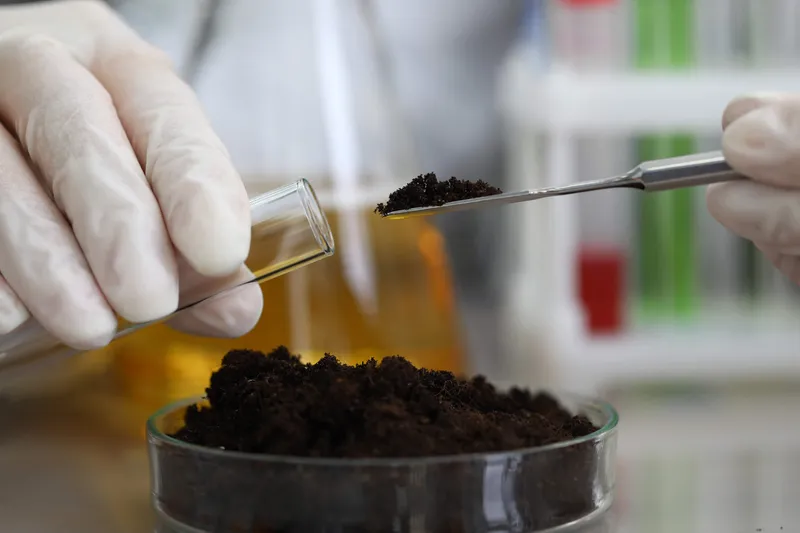
PFAS sample preparation must recover compounds with different chain lengths and functional groups while controlling contamination and matrix interference. A procedure that performs well for drinking water may fail when applied to soil, biosolids, or tissue.
The matrix determines how the laboratory homogenizes the sample, releases PFAS, removes co-extractives, and prepares the final extract for LC-MS/MS. Laboratories must therefore select preparation steps as part of the analytical method rather than adapt a generic extraction at the bench.
Aqueous Samples
Water appears simple, but suspended solids and dissolved organic matter can change extraction performance. PFAS may occur in the liquid phase or associate with particles, making filtration or subsampling a consequential decision.
EPA Method 1633A directs laboratories to analyze the entire aqueous sample without filtration. The method adds isotopically labelled standards before extraction, uses solid-phase extraction (SPE), and includes carbon cleanup.
Suspended solids can slow or block the SPE cartridge. Method 1633A uses total suspended solids to assess that risk and sets different procedures for aqueous and solid samples. When a sample contains too much particulate material for the standard aqueous procedure, laboratories may need a smaller collected volume or a matrix-appropriate alternative permitted by the method and project plan.
Working in analytical science?
Register for a FREE Separation Science account to subscribe to the Separation Science Newsletter.

Processing the complete sample also captures material that may remain on the container walls. Subsampling can alter the relationship between the dissolved and particulate fractions and should not become a routine response to difficult samples.
Soil and Sediment
Soil and sediment present challenges that water samples do not. PFAS recovery can depend on particle size, organic carbon, moisture content, and the strength of interactions between the analytes and the matrix.
Method 1633A requires homogenization and determination of percent solids. The laboratory reports results on a dry-weight basis but extracts a defined mass of homogenized sample. Isotopically labelled standards must enter the workflow before extraction so they experience the same losses and matrix effects as the target compounds.
The method extracts solid samples using basic methanol, followed by carbon and SPE cleanup. Other project-specific procedures exist. For example, an accelerated solvent extraction study of PFAS in soil recovered acids, sulfonates, fluorotelomer sulfonates, and sulfonamide compounds across a range of chain lengths.
Such approaches require validation for the intended application. Strong recovery from one soil does not guarantee equivalent performance in a matrix with a different composition.
Biosolids
Biosolids combine high solids content with organic material and potential co-contaminants. These characteristics can suppress ionization, contaminate the LC-MS/MS system, and produce extracts that require extensive cleanup.
Homogenization must produce a representative analytical portion from a heterogeneous sample. Laboratories also need to control the dry mass entering the extraction. Method 1633A sets a lower maximum dry sample mass for biosolids than for soil or sediment, reflecting the matrix burden introduced during preparation.
Carbon and SPE cleanup remove interferences before analysis. The laboratory should use labelled-standard recovery and matrix quality-control results to determine whether the procedure controls suppression and analyte loss.
The Separation Science article on PFAS testing in biosolids explores the connection between sample preparation, matrix variability, and interference separation in greater depth.

Fish and Other Tissue
Tissue introduces proteins, lipids, and biological variability. The analytical result also depends on which portion the project defines: whole fish, fillet, organ, composite, or another tissue type.
The laboratory must homogenize the defined tissue before taking the analytical portion. Method 1633A uses a wet-weight tissue aliquot and extracts it with potassium hydroxide and acetonitrile, followed by basic methanol. The extract then undergoes carbon and SPE cleanup.
Equipment can become a contamination and carryover source during grinding or maceration. Method 1633A requires cleaning between samples and an equipment blank for each preparation batch involving tissue homogenization.
An automated PFAS sample preparation workflow for fish tissue demonstrates how laboratories can reduce manual transfers across homogenization, extraction, and concentration. Fewer transfers may improve consistency, but automation still requires contamination checks and method-specific performance data.
Milk and Other Foods
Food matrices vary more widely than a single preparation method can accommodate. Milk contains proteins and fats, while meat, produce, seafood, and processed foods bring different water contents and co-extractives.
Food laboratories must assess extraction recovery, lipid removal, protein precipitation, matrix effects, and the stability of the target compounds throughout preparation.
Online cleanup and multidimensional separation can reduce manual preparation in some applications. Two-dimensional LC-MS for PFAS food testing provides one route for separating target compounds from matrix components before detection.
These workflows should match the food type and analytical objective. A procedure developed for milk cannot move directly to eggs, fish, or produce without demonstrating acceptable performance.
Use Labelled Standards to Track the Workflow
Isotopically labelled standards help laboratories identify losses and matrix effects. Their point of addition matters. Standards added before extraction can track more of the preparation process than standards added to the final vial.
A labelled compound does not correct every problem. It may behave differently from a target analyte without an exact matched analogue, and acceptable recovery does not prove that all matrix interference has been removed. Laboratories should evaluate labelled-standard results alongside blanks, spikes, duplicates, and calibration performance.

Balance Recovery and Cleanup
More cleanup does not guarantee better data. Each additional step may remove interference, but it can also introduce contamination, analyte loss, and variability.
The laboratory should assess whether cleanup improves the final measurement by examining:
- Target and labelled-standard recoveries
- Ion suppression or enhancement
- Extract appearance and instrument contamination
- Blank contribution
- Precision across replicate preparations
- Reporting limits achieved in the matrix
Together, these measures show whether the preparation provides a clean extract without sacrificing the compounds of interest.
Match the Workflow to the Matrix
PFAS sample preparation succeeds when each step addresses a defined matrix problem. Water methods must preserve the complete sample. Solid methods must achieve representative homogenization and extraction. Tissue and food methods must manage biological material without losing trace analytes.
Method requirements provide the starting point. Matrix-specific performance data then show whether the laboratory can generate defensible results from the samples it receives.
This article was produced under Separation Science's AI Editorial Guidelines.

