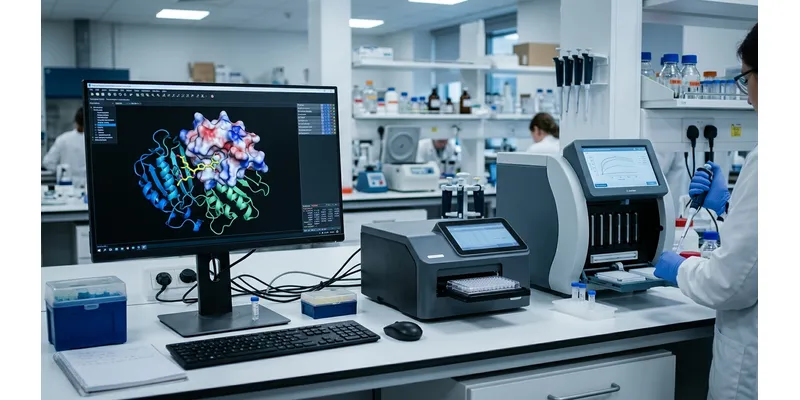
Translating in silico antibody designs into experimentally confirmed binding improvements has remained a persistent gap in computational protein design, as most published results rely on self-selected datasets rather than independent wet-lab validation. Zymo Research reports placing among the top four teams in the AIntibody Design Challenge, an international prospective competition involving 29 academic, biotechnology, and pharmaceutical organizations in independently validated computational protein engineering. The company states its platform generated antibody variants with binding affinities up to 75-fold higher than their parent molecules, with several candidates reaching picomolar-level binding.
Prospective Benchmarking Sets a Higher Standard for Computational Protein Design
Most published computational antibody results draw on retrospective analyses, which can overstate accuracy. AIntibody's design, inspired by the Critical Assessment of Structure Prediction (CASP) framework, addressed this by synthesizing and testing all 511 submitted sequences under identical conditions across 29 organizations before any team saw results. This prospective, blinded structure makes performance claims directly comparable across all participating teams, regardless of the computational approach used.
Working in analytical science?
Register for a FREE Separation Science account to subscribe to the Separation Science Newsletter.

The International Council for Harmonisation (ICH) Q6B guideline, which sets biologics specifications and testing criteria for FDA review, requires computational designs to translate into molecules meeting measurable physicochemical and functional criteria. AIntibody applied that same standard as a competition entry requirement, using standardized affinity and developability assays to evaluate every submission. The findings, published in Nature Biotechnology, show that AI matched experimental affinity results in defined, data-rich conditions, though success did not transfer consistently across all three challenge tasks.
"Achieving top-tier performance in a blinded, experimentally validated challenge is an important demonstration of what our computational protein engineering platform can deliver," said Dr. Larry Jia, Founder and CEO of Zymo Research.
Zymo Research reports the following performance figures from the affinity maturation sub-challenge, in which 25 organizations competed:
- Up to 75-fold improvement in binding affinity versus parent antibodies
- Picomolar-level binding affinities achieved across multiple candidates
- Top-four ranking in the affinity maturation sub-challenge
- 511 AI-designed antibodies submitted and experimentally tested across all three challenge tasks
- Standardized affinity and developability assays used to evaluate every entry
How Does Computational Protein Engineering Fit into Drug Discovery Workflows?
In therapeutic antibody development, one of the costliest steps is improving the binding strength of a validated parent antibody through iterative experimental rounds. Computational protein engineering targets this directly by generating optimized sequence variants in silico, reducing the number of experimental cycles needed before a lead candidate reaches selection. The AIntibody affinity maturation sub-challenge reproduced this scenario directly, with teams receiving sequencing data from an existing antibody campaign and submitting designs targeting improved binding against the SARS-CoV-2 receptor-binding domain, with all variants then synthesized and tested under uniform conditions.
Zymo Research describes its platform as applicable across several stages of the antibody development pipeline, from lead optimization and biosimilar development through to diagnostic reagent design, based on its publicly stated research areas and the press release.
| Workflow Stage | Computational Protein Design Application |
|---|---|
| Lead Optimization | Affinity maturation of candidate antibodies against validated therapeutic targets |
| Discovery Screening | Computational pre-filtering of large sequence libraries to prioritize high-affinity candidates |
| Biosimilar Development | In silico assessment of sequence variants for developability and binding equivalence |
| Vaccine Antigen Engineering | Structure-guided design of antigens with improved immune response properties |
| Diagnostic Reagent Development | Engineering capture antibodies for high-sensitivity immunoassay platforms |
Dr. Jia adds: "Achieving top-tier performance in a blinded, experimentally validated challenge is an important demonstration of what our computational protein engineering platform can deliver." The company states it is continuing to invest in its protein design and engineering infrastructure and is seeking collaborations across AI, sequencing, and protein engineering.
Zymo Research's AIntibody Result in Context
Zymo Research reports that its computational protein design platform generated antibody variants with up to 75-fold affinity improvements and picomolar-level binding in the AIntibody Design Challenge, a blinded international benchmark in which all 511 submissions from 29 organizations were synthesized and tested under identical conditions. The Nature Biotechnology paper uses masked identifiers for all non-winning teams, so Zymo Research's specific top-four ranking is reported by the company rather than independently confirmed in the published record. The company is continuing to expand the platform and is open to collaborations in AI, sequencing, and protein engineering.
This article is based on a Zymo Research press release and was produced under Separation Science's AI Editorial Guidelines.